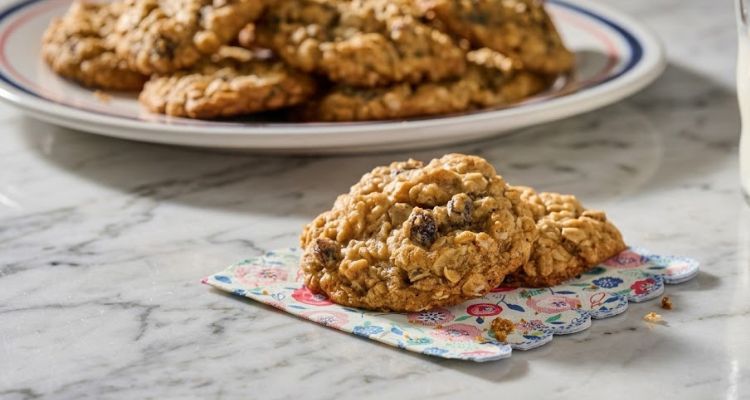
Pioneer Woman oatmeal raisin cookies cream butter with brown and granulated sugar, then fold in 3 cups of rolled oats and plump raisins with a hint of cinnamon. And Ree Drummond’s recipe makes 42 cookies at around 120 calories each in about 50 minutes, since the dough needs no chilling before scooping.
Ree Drummond uses vanilla bean paste instead of plain extract, which leaves tiny vanilla specks throughout the dough and adds a deeper, more rounded flavor. That one swap is subtle, but it pushes these past the generic oatmeal cookie into something that tastes like it came from a bakery counter.
Folding the oats and raisins in by hand with a spatula at the end is the step that protects the cookie’s texture, because the stand mixer would crush the oats into powder and mash the raisins. Gentle turns keep the oat flakes whole, so each cookie bakes up chewy instead of cakey.
Source: The Pioneer Woman (Ree Drummond)
Pioneer Woman Oatmeal Raisin Cookies
Course: Desserts, SnacksCuisine: AmericanDifficulty: Easy42
servings10
minutes50
minutes120
kcalButter creams with brown sugar, granulated sugar, and vanilla bean paste before eggs beat in one at a time. Then a cinnamon-spiced flour mixture folds in on low speed, and 3 cups of oats and raisins stir through by hand. And 1 1/2-tablespoon scoops bake at 350°F for 10 to 12 minutes, so every cookie comes out golden at the edges and soft in the middle.
Ingredients
- For the dry ingredients:
1 1/2 cups all-purpose flour
1 tsp baking soda
1 tsp ground cinnamon
1 tsp kosher salt
- For the dough:
1 cup (2 sticks) salted butter, room temperature
1 cup packed light brown sugar
1/2 cup granulated sugar
2 tsp vanilla bean paste or vanilla extract
2 large eggs
- For the mix-ins:
3 cups old-fashioned rolled oats
1 cup raisins
Directions
- Preheat and line: Set the oven to 350°F, then line 2 baking sheets with parchment paper so the cookies release cleanly.
- Whisk the dry ingredients: In a medium bowl, combine the flour, baking soda, cinnamon, and salt, then set aside.
- Cream the butter and sugars: In a stand mixer with the paddle, beat the butter, brown sugar, and granulated sugar on medium-high for 3 to 5 minutes until fluffy and light in color.
- Add the vanilla and eggs: Beat in the vanilla bean paste, then add the eggs one at a time, scraping the bowl after each so the dough stays smooth.
- Mix in the flour: Reduce the speed to low, then gradually add the flour mixture and mix just until combined, since over-mixing toughens the cookies.
- Fold in the oats and raisins: Remove the bowl from the mixer, then stir in the oats and raisins by hand with a rubber spatula so the flakes stay whole.
- Scoop and space: Drop half the dough in 1 1/2-tablespoon balls onto the prepared sheets about 2 inches apart, because they spread as they bake.
- Cool on the sheet: Let the cookies rest on the baking sheet for 5 minutes, then transfer to a wire rack to cool completely.
- Repeat with remaining dough: Let the sheets cool before scooping the second batch, since hot pans cause the butter to melt before the cookies reach the oven.
FAQs
Why does the recipe call for vanilla bean paste instead of extract?
Vanilla bean paste is thicker than extract and contains the tiny seeds from the vanilla pod, so you get visible specks and a more intense, rounded vanilla flavor. Extract works as a direct swap at the same 2 teaspoon amount, though you lose those visual flecks.
The paste also holds up better during baking because its thicker consistency doesn’t evaporate as quickly as the alcohol-based extract. If you can find it at the store near the regular vanilla, it is worth the extra cost for cookies where vanilla is a featured flavor.
Can I use instant oats instead of old-fashioned?
Ree recommends sticking with old-fashioned rolled oats, because instant oats are finer and absorb more moisture from the dough. That extra absorption leaves the cookies dry and crumbly instead of chewy, since the oats pull liquid away from the butter and eggs.
Rolled oats hold their shape during baking, which gives each cookie its signature texture and visible oat flakes. Steel-cut oats don’t work either, because they stay too hard and crunchy without cooking.
Do I need to chill this dough before baking?
No chilling is needed, which is one of the reasons Ree calls this recipe quick and easy. The dough scoops straight from the bowl onto the baking sheet, so you can have warm cookies in under an hour.
If your kitchen runs very warm and the dough feels too soft to hold a round shape, 10 minutes in the fridge firms it up. But under normal conditions, skipping the chill means you go from mixing to eating faster than almost any cookie recipe.
Can I freeze the dough for later?
Scoop the dough into balls, freeze them solid on a parchment-lined sheet, then transfer to a zip-top bag for up to 3 months. Bake straight from frozen at the same temperature, and add a few minutes to the cook time until the edges turn golden.
This freeze-and-bake approach means you always have fresh cookies available without mixing a new batch. The oats and raisins hold up well in the freezer, so the texture stays the same as a freshly mixed cookie. For another Pioneer Woman cookie that freezes just as well, try the Pioneer Woman chocolate pie for a different sweet fix alongside.
What can I add or swap to change these up?
Walnuts or pecans at 1/2 cup folded in with the oats add crunch without changing the base recipe. Dried cranberries swap directly for the raisins if you want a tarter flavor, and chocolate chips mixed with the raisins push them into trail-mix territory.
Ree notes these are inspired by her brown sugar oatmeal cookies, so the base is flexible enough to handle most mix-in swaps. Keep the total add-in volume around 4 cups combined so the dough holds together. And for another Ree cookie that handles mix-in swaps well, the Pioneer Woman peach cobbler shows a similar flexible approach with fruit.